
 Dr. Sarah Lewis is a criminologist and a penal reformer based out of the United Kingdom who specializes in cultural change within prisons and corrections. She has 20 years of experience in and out of probation and prison settings. As the director of Penal Reform Solutions and Grow, Transform, Belong CIC, Dr. Lewis oversees a team of people with personal and professional lived experience who work together to bring about social change in correctional environments.
The theme of this bulletin is particularly relevant in Dr. Lewis’ work, as maintaining professional boundaries in correctional environments is essential in cultivating a healthy, productive, and functioning system. Facilities with frequent boundary violations are infiltrated with distress, distrust, and corruption. In this interview, Dr. Lewis discusses the impacts of such behavior on the system as well as provides recommendations for correctional leaders and practitioners to create a better system, regardless of your background or specialty.
The Dynamic Model of Professional Relationships: Red Zones vs. Green Zones
Expanding beyond therapeutic relationships, the dynamic model includes our relationships with our peers, colleagues, leaders, and even ourselves. An essential point in understanding cultural shifts in correctional environments is that they are ever changing, influenced by both current staff and incarcerated people, facility or governmental policies, and other dynamic factors. In order to secure of positive professional relationship, a shared goal, and understanding of the needs of an individual are required alongside the tasks that will help achieve this goal.
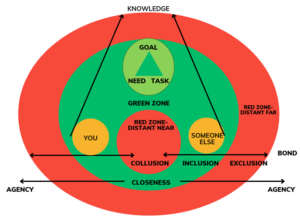
The final element of the model is the psychological distance between two people, as people negotiate how close they become based on a feeling of psychological safety. Participants can thrive, feeling mutually safe in the green space, or distance themselves away from others (the distant far position) or get too close to the individual (the distant near position). Knowledge has clarity and honesty in the green zone, but is distorted in the red zones, that individual a lack of trust and a position of protection and survival.
A number of things need to be in place for relationships in these settings to thrive, which include both the individual and the organization. This model describes both as operating in either green or red zones, depending on the social and professional culture, which can affect risk factors associated with staff boundary violations. Learn additional information about the model here.
Red Zones – Risk Factors
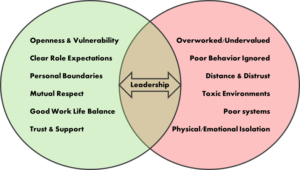
Red zones describe environments where there is little collaboration or consistency among levels. When staff are overworked, undervalued, and underappreciated, when poor behavior is overlooked or erroneously handled, the whole system suffers. Institutions functioning in red zones may contribute to psychological detachment and emotional distance among staff, leading to isolation and disconnection between colleagues. Toxic environments characterized by discrimination, corruption, and hypermasculinity can lead to similar outcomes, reducing the ability for people to be appropriately vulnerable. People are less likely to report issues or ask for help. Of particular relevance, correctional staff who feel or appear emotionally or physically isolated are at heightened risk of being targeted by residents within prisons who have goals to groom, manipulate, and compromise staff.
Green Zones – Protective Factors
Green zones describe positive and functional working environments. Dr. Lewis described examples in corrections as when there is emotional openness and vulnerability among staff and leaders. People can ask questions and feel comfortable expressing their needs. There are clear expectations regarding roles and boundaries. Staff are able to say “no.” There is mutual respect between staff and incarcerated people as well as between staff and their colleagues or supervisors. People feel supported by leadership and trust their peers. Staff, regardless of title, are able to maintain a good work-life balance. The more individuals operating in the green zone, the more likely the institution, as a whole, will demonstrate the same. In Dr. Lewis’ words, “normalizing the green” normalizes vulnerability and good communication, which inspires positive culture, which allows for high impact and effective work. Institutions operating in green zones are safer, see fewer boundary violations, and have better outcomes, generally, for correctional staff and incarcerated people.
The Ripple Effects of Boundary Violations
 When a correctional staff member violates professional boundaries (e.g., inappropriate relationships, introduction of contraband, neglect of residents, etc.), there is system-wide impact on trust and safety. If that individual is put on administrative leave or fired, their colleagues are required to cover the neglected job duties. When staff are spread too thin, security of the institution is at risk, as staff may be unable to perform all of their job duties promptly and thoroughly. When trust is lost with an individual, that distrust can spread to other colleagues as well, infecting the prison culture as a whole. How are you supposed to trust those who are responsible for protecting you when they are caught engaging in behaviors that threaten the safety and security of the institution? Such outcomes are exacerbated when leaders violate boundaries, as distrust and distress can trickle from the top down.
The Human Factor: Who’s at Risk?
Most importantly, Dr. Lewis emphasizes that we think about the question “why do people violate boundaries?” curiously and compassionately. You may be quick to jump to conclusions about such scenarios. However, it is often more complex than that. There are many emotionally intelligent, mindful, effortful correctional staff (across all specialties), but there are also some who abuse their positions of power. Staff in certain departments may be perceived as at heightened risk of crossing boundaries simply due to their profession. For example, correctional psychology staff are often perceived as “too nice” or “too trusting” when engaging with incarcerated people, leading to misconceptions that people in those roles are motivated to cross professional boundaries. Rapport-building techniques are misinterpreted as inappropriate or naïve in nature. In reality, the isolation experienced by individuals when a department is not viewed as a collaborative addition to custody is what increases risk of boundary violations.
Custody staff tend to be more emotionally distant and detached than those in psychology (or similar roles). However, these individuals may be more at risk of violating professional boundaries if there are unhealthy work dynamics that isolate them or scenarios in which they do not have an appropriate outlet to address their needs. Emphasizing cooperation between custody and psychology is best for creating a green zone environment. Stereotypes about certain correctional roles create tension between departments. Encouraging understanding and mutual respect is essential in creating a supportive working culture across the institution.
Correctional staff are at heightened risk of negative outcomes when institutions operate in the red zone. When prisons take on a punitive perspective with those incarcerated, the same perspective is spread to staff. Expectations that staff has to simply “be tough” or “just get over it” are damaging. Working in a (literally) locked environment can be distressing for some and institutions operating in the red zone only exacerbate these experiences. Creating trauma-informed working environments is essential for the success of both the individual and the system. Moral injury can be just as difficult to experience and recover from as physical injury. Staff experiencing moral injury are more likely to experience anxiety and depression and are at increased risk for self-harm and suicide. Generally, people simply want to fit in. Thus, it is difficult to speak up for yourself or for others when you are enveloped in a system that does not encourage such behaviors, making moral injury a significant problem in institutions operating in the red zone.
Moral Courage and Transparency
Whistleblowing and Speaking Up
An essential part of Dr. Lewis’ Justice 2.0 framework, a campaign to improve criminal justice systems across the world, is that is takes courage to speak up, but doing so is essential in creating social change in correctional environments (Read more about Justice 2.0 in the May/June 2025 issue of the IACFP bulletin). In this interview, Dr. Lewis described that whistleblowers demonstrate significant moral courage, speaking up despite knowing the risks of shame or anger from colleagues. Without those who are willing to speak up, unethical, immoral, or illegal behavior continues. 
However, there is this culture in prison around “snitching,” and not just amongst those incarcerated. Even correctional staff may discriminate or retaliate against staff who report concerns amongst other staff members, deterring some staff from reporting concerns at all. To challenge this culture, Dr. Lewis recommended that safer procedures for reporting be in place. As “snitching” culture sometimes even expands to leadership, more anonymity is needed for staff to be able to report concerns without risk of retaliation or alienation. Access to third-party resources can also assist with anonymous or confidential reporting when staff do not feel comfortable or safe reporting directly to internal staff.
Internal and External Transparency
When an issue does occur, it is important for correctional leaders to consider the risks and benefits of transparency, both within the institution and externally. Even when leadership decides not to share information with staff, gossip runs rampant behind (and around) prison walls. When there is little trust and minimal understanding, people fill in the gaps. These patterns can be harmful to the institution and any individual involved (including those who report). Staff may feed into rumors. Media outlets may stigmatize and shame institutions or the people within them, portraying an inaccurate picture that negates the positive impact professionals can have on the lives of those in prison or on probation.  Dr. Lewis recommends transparency always, albeit within reason. Some details are unable to be shared, but gossip and misconceptions are best thwarted through straightforward and honest communication. Correctional leadership can help provide alternative narratives before media gets involved by being transparent with the public, which requires transparency from first-level supervisors with executive leadership. Representatives can emphasize steps being taken to address the issue and prevent future occurrences. They can also balance negative incidents with positive achievements. As was discussed in the piece titled Interview: Dr. Susan Rudolph on Not Just Caring for Your Clients, But for Your Colleagues and Yourself, in a High Stress Environment in the September/October 2025 issue of this bulletin, media attention to corrections is often for negative instances. Sharing more positive and complete stories may inform public perceptions with facts and additional information, combatting misconceptions about corrections, which also affect the health and safety of the working environment. Internal staff can better understand the outcomes and consequences of a situation, deterring similar behavior and encouraging others to come forward when such incidents occur.
Practical Recommendations
Obstacles to Reform
Political narratives and external pressures can create significant, uncontrollable barriers to change. However, although we cannot control what others say or do, we can control how we respond. Dr. Lewis recommends building a counter narrative against harmful rhetoric or misconstrued messages, through social media, staff training, and other communication procedures. Similarly, fear and chaos make it difficult for people to know what to believe. Staff may feel uncomfortable stepping in or speaking up when they are not sure what to do or if they worry about the outcomes of such a behavior. Compliance-oriented systems result in whistleblowers being excluded. The inability to be vulnerable or honest prevents people from coming forward and allows negative environments to flourish, decreasing safety for staff and incarcerated people, while increasing risk of future boundary violations.
For Individual Practitioners
Although systemic barriers to creating change in correctional environments may appear daunting, Dr. Lewis recommends several strategies that can assist in starting that change:
- Build a support network, finding others who are on the same page or are “in the green” with you.
- Collaborate with other departments and discuss new ideas.
- When internal support fails (or does not appear to be available), get in contact with people through external associations (e.g., IACFP, Justice 2.0, etc.).
- “Create disruption” when you can. In other words: Make waves. Intervene. Speak up when you feel comfortable doing so.
- Introduce diversity into systems plagued with “groupthink” tendencies.
A fun analogy that Dr. Lewis has heard from Iridian Grenada, an advisor of Justice 2.0, is “If you aren’t invited to the party, make your own party.” Create your own sense of belonging if necessary. Having good support buffers the negative effects of working in a correctional environment, which is good for your wellbeing (and reduces the likelihood of boundary violations).

Change can be difficult, and slow. You do not need to go 100% all the time. In order to create meaningful change, you need to give yourself time to refuel. Sometimes there is only so much you can do as an individual and it is important to be patient and kind to yourself when that happens. Moving on does not mean you did not fight hard enough. Being unwilling to let something go can be distressing and exhausting. And if all the good staff burn out, there will be nobody left to foster that change. Additionally, and perhaps most importantly, Dr. Lewis encourages practicing self-compassion.
Additional Recommendations for Newcomers
For those considering entering corrections with a motivation to foster change, Dr. Lewis has three main pieces of advice:
- Be humble.
It can be easy to want to come in and demand the world. However, change requires support, and it is unlikely that other staff will be willing to join your crusade if you come in telling everyone everything they are doing wrong. Understand that there are things you do not know, despite how much schooling or research you feel you have done in preparation.
- Be curious.
Be willing to learn from experience. Ask questions, try out new roles, get to know those who have been in service for a long time or in other departments. Part of progressing in a system is understanding how it has worked in the past and seeing how areas you are unfamiliar with function.
- Be compassionate.
As was mentioned previously, it can be easy to cast judgment onto those whose behavior you do not approve of. Consider the situation with curiosity and compassion. What led to this? What systematic barriers or risk factors are in place? What can you do (realistically) to help build a better system? Understanding questions like these will help you understand best how to foster change.