
Earlier this year, Deviant Behavior (Volume 46, Issue 4, 2025) published an article by Bryce E. Peterson and KiDeuk Kim in which these authors evaluate potential motivations behind staff boundary violations in United States correctional facilities, including inappropriate relationships, financial gain, and staff isolation. This research emphasizes systematic risk factors associated with increased boundary violations, a perspective that has is essential in considering policy reform in correctional environments.
Background
Those who work in corrections are responsible for the health and safety of incarcerated individuals. Correctional staff who violate professional boundaries weaken this goal, creating environments that are unsafe for both incarcerated people and their colleagues. In previous research, boundary violations have included instances in which staff have interacted with incarcerated people in ways that violate institution policy or law, such as through medical or psychological neglect, introduction of contraband, sexual harassment or assault, and any otherwise inappropriate relationships or behaviors. Peterson and Kim sought to evaluate prison level-factors that are associated with increased contraband in prison facilities.
 Contraband, which can include any physical item that violates prison policy, can be introduced via staff or visitors (e.g., illicit substances, cell phones, etc.) or made within prison walls (e.g., weapons, alcohol, etc.). Staff who do introduce contraband most often include items that cannot be made, such as drugs or cell phones. Drug use, which is a frequent and significant issue in prisons, increases risk of overdose and decreases safety, as illicit substances can contribute to dangerous power dynamics amongst incarcerated people and increases risk of substance-induced aggression or psychosis. Cellphones also pose a significant safety risk. Although some incarcerated people utilize them to speak with family, cellphones also allow for people to organize criminal activity both inside and outside of prisons and pose a security risk to the overall institution.
Prior research suggests that the social climate of correctional institutions plays a large role in motivations behind staff violating certain professional boundaries. These authors focus on three specific factors: gender differences, financial motivations, and understaffing. Due to motivations to introduce contraband in response to romantic or other inappropriate relationships between staff and incarcerated people, these authors hypothesized that institutions with more female staff would have more incidents of contraband recovery.

They also hypothesized that institutions with lower average salaries would have more incidents of contraband recovery. Lastly, they hypothesized that facility staffing would demonstrate a nonlinear pattern, such that as staffing proportions decrease, more contraband would be recovered, but once staffing proportions got to a significant low amount, staff would be unable to keep up with their typical duties, resulting in fewer contraband recoveries.
Methodology
This project emphasized themes across jurisdictions, with the authors analyzing data from the National Survey of Correctional Contraband (NSCC) covering 301 male or female correctional institutions in six U.S. states: Arkansas, Florida, Oregon, Tennessee, Texas, and Wyoming. Dependent variables included the total number of drug recoveries and the total number of cellphone recoveries in each institution in the 2018 calendar year. Main independent variables calculated for each facility included proportion of female staff, average income (for correctional officers), and resident to officer ratio (referring to the number of prisoners compared to the number of staff). Additional variables are detailed in the published article (Peterson & Kim, 2025).
Key Findings
On average, facilities reported 28 incidents of drug recovery and 31 instances of cellphone recovery over the calendar year. Approximately 42% of staff were female, a number that is expected to be positively skewed due to higher proportions of female staff in female-only facilities. When looking at male-only institutions, all (except one) employed at least 15% female correctional staff. Average annual salary for staff was $48,521.97 (USD), which was approximately $4,613.03 (USD) less than the median salary of the county in which each facility was located. The average resident to officer ratio was approximately 6:1.
Gender Differences
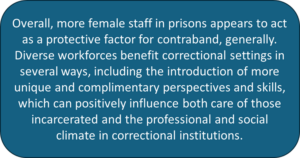
 Contrary to what was hypothesized, analyses indicated that, across both male and female facilities, those with higher percentages of female staff had fewer instances of drug and cellphone recoveries. When only analyzing male institutions, this statistic was reversed, in line with hypotheses that institutions with more female staff also had more cellphone (but not drug) contraband recoveries. However, the authors emphasized that this association was only significant in one of the models and, thus, appears to be less statistically relevant than the finding that increased gender diversity acts as a protective factor in prisons.
Financial Motivations
 Analyses did reveal a significant negative association between staff salary and both drug and cellphone contraband recoveries. However, this effect was small, with estimates indicating facilities may need to increase the average salary by $10,000 (USD) to reduce drug recoveries by approximately 1.1 per year and cellphone recoveries by approximately 2.5 per year. This does not appear to be a realistic approach to reducing the introduction of contraband in prisons. Additionally, this association may be more related to perceived relative salary rather than relative salary itself, a variable that may require more individual-level assessment than the system level variables that were assessed in this study.
Understaffed Institutions
 Analyses supported the hypothesized nonlinear relationship between resident to staff ratios and contraband recoveries. More specifically, as staffing shortages (resident to staff ratios) increased, both drug and cellphone contraband recoveries also increased until shortages became so severe that recoveries decreased again. As was hypothesized, the authors argued that the decrease in recoveries in institutions with excessively high resident to staff ratios was less representative of a decrease in contraband and more so representative of staff’s inability to thoroughly conduct duties in which contraband is typically discovered (e.g., cell searches, pat downs, etc.)
Implications for Research and Practice
These authors argue that increases in contraband recoveries in male-only prisons with more female staff may be representative of male residents’ increased attempts to manipulate and compromise female staff. Rather than these incidents calling for institutions to decrease proportions of female staff, this outcome emphasizes that correctional leaders provide training that emphasizes motivations and strategies used by residents when they attempt to compromise staff, as well as for more resources to better support female staff in a male-dominated profession.
Financial motivations appeared to be only marginally related to contraband recoveries. Thus, rather than considering actual relative wages of correctional staff, individual perceptions of if their salary matches one’s perceived worth should be assessed. This variable may not be observable at a systemic level, but significant associations in this study call for additional research to assess financial motivations for introducing contraband, perhaps at the individual level.
Lastly, and perhaps most relevant to policy and practice, increased resident to staff ratios increase contraband recoveries, as it is expected that staff who do introduce contraband are better able to do so when facilities are short staffed and less supervised. However, contraband recoveries decreased again when resident to staff ratios increased significantly, suggesting that correctional officers in severely understaffed institutions may not be able to perform duties essential in finding and reporting contraband. Thus, understaffing may have additional, severe implications for the safety of institutions when officers are unable to take the time to perform thorough searches. In terms of practice, this finding emphasizes the importance of approaches to staff recruitment and retention, which is not surprising to most correctional professionals. Additionally, although outside of the scope of this paper, it is recommended that future researchers consider how these findings may be indicative of additional variables associated with understaffing, such as increased stress, burnout, and isolating or exclusive correctional working environments.