
The most recent issue of Criminal Justice and Behavior (Volume 59, Issue 9, September 2025) has published an article by Samantha L. Allen and Joseph A. Schwartz detailing a longitudinal study examining the prevalence and persistence of significant mental health concerns in correctional officers in relation to service time. The findings of this study provide important perspectives for leadership in correctional settings when considering mental health and wellness of themselves and their staff.
Background
Despite recent increases in state prison populations, the number of state correctional employees in the United States has continued to decline over the years. Employee shortages have made it more difficult to fully staff housing units, requiring institutions to more frequently rely on lockdowns to preserve institutional security. Prior research has indicated that these punitive approaches to corrections have similar negative effects on correctional staff as they do on incarcerated people, which may deter staff from working in these environments long term or from applying for such positions in the first place. Although correctional officers have been found to have higher rates of several mental health diagnoses (e.g., PTSD, anxiety, depression, etc.), Allen and Schwartz are among the first to assess these experiences in relation to how long officers have worked in corrections.
The resiliency-fatigue model describes the process in which people are resilient to stress up to a certain point but are no longer able to effectively cope after extreme stressors or extended stress has occurred. Once this threshold of resiliency is passed, people are more at risk of developing serious mental health problems. Allen and Schwartz argue that the buildup of occupational stressors in a correctional environment may replicate the resiliency-fatigue model, such that officers that have worked in correctional settings for longer periods of time may be less resilient to additional work stressors later in their careers. The factors thought to most significantly affect correctional officer turnover are job stress and burnout, both of which have been found to occur more frequently for officers exposed to more significant stressors on the job (e.g., violence, traumatic events, etc.). However, some research has also indicated that service time may act as a protective factor, as officers who are willing and able to remain working in corrections may be more committed and content with their roles. Thus, more research is needed to determine the role of service time in correctional officers’ wellbeing.
In this study, Allen and Schwartz aimed to address the prevalence and persistence of mental health problems in correctional officers by taking a longitudinal approach to data collection. Most importantly, these authors acknowledge that the presence of mental health issues may change throughout an officer’s career and emphasize the importance of longitudinal designs in making claims about causality.
Methodology

Correctional officers from three Minnesota Department of Corrections (DOC) institutions were recruited for this study. Data were collected from officers at each institution at three different time points (per cohort) approximately every six months between July 2018 and January 2020. Officers who agreed to participate completed surveys collecting data on a variety of personal and vocational variables, such as family dynamics, demographic information, history of mental health problems, and workplace perceptions and incidences. Researchers also collected information from recorded officer responses to inmate disciplinary incidents at two different time points throughout the study to avoid relying entirely on self-report data, which may be influenced by recall or desirability biases.
Researchers collected information on self-reported symptoms of Post Traumatic Stress Disorder (PTSD) using the PTSD Checklist from the Diagnostic and Statistical Manual Fifth Edition (PCL-5). Depressive symptoms were measured using the Center for Epidemiologic Studies-Depression (CES-D) instrument. Lastly, anxiety symptoms were measured utilizing the Patient Reported Outcomes Measurement Information System (PROMIS) Anxiety Scale. Service time was self-reported by officers down to the month, with participating officers having worked in corrections between less than a month and more than 30 years, with an average of just under nine years. Lastly, in addition to collecting demographic information (e.g., marital status, sex, race, age, etc.), correctional officers’ perceptions of job control, demands, ambiguity, and conflict were collected as covariates, as well as exposure to violence and most common work shift.
Key Findings
Overall, the strongest predictor of future mental health concerns was past mental health concerns, demonstrating persistence of some symptoms throughout the study period. Most notably, however, when assessing for PTSD symptoms, this effect was moderated by service time. More specifically, for officers with approximately less than one year of service, there was no significant difference between officers who did and did not exhibit PTSD symptoms at Wave 1 in the in likelihood of experiencing PTSD symptoms at Wave 3. However, for officers with more than 1 year of service, this effect increased significantly. In other words, officers who exhibited PTSD symptoms at Wave 1 were significantly more likely to also exhibit PTSD symptoms at Wave 3, but this likelihood nearly doubled as years of service increased towards 30 years. The authors suggest this finding may be a combination of the persistent nature of PTSD symptoms and the impacts of exposure to more frequent and more intense stressors as service time increases.
Officers who exhibited anxiety and/or depressive symptoms at Wave 1 were also more likely to exhibit similar symptoms at Wave 3. However, this effect was not moderated by service time. Thus, officers who exhibited symptoms of depression at Wave 1 (compared to those who did not) were significantly more likely to also experience depressive symptoms at Wave 3, regardless of service time. Interestingly, officers who exhibited anxiety symptoms at Wave 1 (compared to those who did not) were more likely to also experience anxiety symptoms at Wave 3, however, this effect became nonsignificant for officers with more than 20 years of service time. More specifically, as service time increased, officers who exhibited anxiety symptoms at Wave 1 became less likely to experience symptoms at Wave 3, while those who did not show anxiety symptoms at Wave 1 were more likely to experience symptoms at Wave 3. The authors suggest that this finding is representative of an attenuating effect that service time has on anxiety, proposing that officers without anxiety exhaust anxiety coping skills as service time increases, while officers with anxiety adapt to the stress of correctional environments.

Conclusions
The authors discussed the differences in persistence of symptoms associated with anxiety or depression compared to PTSD, emphasizing the perpetual nature of PTSD symptoms, which can persist or recommence even long after the traumatic event occurred or after having not experienced symptoms for some period of time. However, depression and anxiety are less defined by persistent symptoms or significant changes to a person’s believe symptoms. Thus, more service time may not impact these experiences in the same way as it does PTSD symptoms.
The authors recommended several practical applications of this research. Particularly, they focused on encouraging supportive working environments for correctional workers. As many correctional institutions struggle with staff shortages, emphasizing staff wellness can help with retention. Fully (or more fully) staffed institutions have fewer occupational stressors (e.g., burnout, traumatic events, security concerns, etc.) creating a more supportive environment for correctional staff. Additionally, expanding mental health resources in correctional environments and encouraging officers to utilize mental health services may help alleviate stress in institutions with chronic staffing shortages.
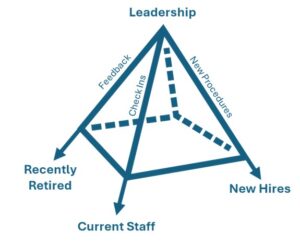
Overall, these authors demonstrated that more service time in correctional institutions does not necessarily increase an officer’s mental health resilience. In some cases, prolonged exposure appears to exacerbate persistent mental health problems. Thus, it may be particularly important to consider service time when assessing staff wellbeing. In line with Dr. Hume’s perspectives in the previous piece, organizations may benefit from multilevel approaches to addressing staff wellness. It is equally important for staff to address their own personal needs as it is for those in leadership to demonstrate acceptance and encouragement of utilizing resources and practicing wellness skills regularly. Additionally, organizations can support staff wellness by utilizing trauma-informed strategies in hiring and annual or quarterly evaluation practices, by regularly checking in on staff throughout their career, and by requesting, documenting, and adapting to feedback as staff move in and out of positions or institutions. As you will see in the following articles, these themes appear to be integral to creating supportive, effective approaches to addressing staff wellness.
Tia Tourville, IACFP Communications and Projects Contractor