
 Conventional thinking about suicide prevention in corrections holds that the aim of a suicide prevention program is to prevent suicide, and preventing suicide means the program must identify and respond to suicidal adults. In this paper, I explain why this conventional thinking is too narrow and then present a model of suicide prevention—the 4-Square Model of Suicide Prevention adopted in California prisons—that offers a broader view of what suicide prevention means in carceral settings.
What Are We Trying to Prevent?
Ordinarily, healthcare prevention programs aim to avoid adverse health outcomes by (a) preventing the onset of the condition believed to cause them and (b) treating the condition once it becomes apparent. For example, a program to reduce deaths from heart disease may encourage all people to eat healthily and be physically active. When heart disease appears, clinicians apply a variety of interventions to halt its progression. In a suicide prevention program (SPP), the outcome we wish to avoid is clear: suicide. But what condition must we aim to prevent and treat to avoid suicide? What condition always precedes suicide? A reasonable answer is suicidality. Suicidality is a condition affecting living people who, however briefly, contemplate ending their lives. To say a patient is suicidal is to say they suffer from suicidality severe enough to require treatment. Suicidality includes traditional signs and symptoms, such as suicidal thoughts and suicidal intent (e.g., preparations to die, devising a plan, communications that allude to impending death), as well as emotional, cognitive, and behavioral symptoms (e.g., unbearable pain, rigidly clinging to suicide as a solution, insomnia).
What Is a Suicide Prevention Program?
The distinction between suicide as a kind of death and suicidality as a condition clarifies the aims of an SPP: to prevent, identify, and treat suicidality to avoid the outcome of suicide. To achieve these aims, the program must be complex. It must include multiple components that operate at different levels of the correctional system (Krishnamoorthy et al., 2022). Some interventions are delivered directly to incarcerated people. Others target staff skills, environmental safety, and departmental operations. Some interventions occur upstream; that is, they prevent suicidality by promoting overall well-being, strengthening the resilience of all adults, and screening for early signs of suicidality. Others occur downstream. Once suicidality sets in, downstream interventions respond to and treat the condition. Together, these components form an integrated system of safety nets that can prevent, identify, and treat suicidality.
The 4-Square Model of Suicide Prevention in Corrections
In the California correctional system, we rely on the 4-Square Model of Suicide Prevention to understand the content and scope of suicide prevention efforts. The model addresses suicidality and suicide, recognizes upstream and downstream efforts (i.e., prevention versus treatment), and acknowledges a multi-component, multi-level view. The model consists of four squares: Prevention, Treatment, Preparedness, and Quality. Figure 1 presents the model and the interventions currently used in California prisons within each square.
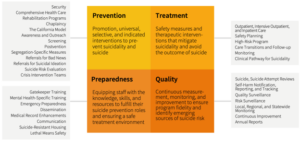
Figure 1. The 4-Square Model of Suicide Prevention in Corrections
The Prevention Square includes components designed to stop suicidality from developing or fully developing. Components in this square are intended to enhance the well-being of all incarcerated people (promotion interventions), apply low-cost interventions to all adults (universal interventions), support select groups who may be at elevated risk of suicidality (selective interventions), and respond to those who may be showing signs of suicidality (indicated interventions). For example, a facility may use educational and vocational programs to support self-efficacy (promotion), conduct suicide screening prior to placement in disciplinary units (selective), and require a suicide risk assessment for any resident reporting suicidal thoughts (indicated).
The Treatment Square is comprised of components meant to treat suicidality to avoid the outcome of suicide. Once suicidality has emerged, treatment is tailored to the severity of the condition. Outpatient care and safety planning may be sufficient for low-severity presentations, whereas high-severity presentations may require psychiatric hospitalization, safety measures (such as enhanced monitoring and means restriction), and a plan for follow-up to reduce the risk of suicide post-discharge. Ideally, programs have a clinical pathway for suicidality, that is, a roadmap informed by evidence and expertise that describes how to care for suicidal patients.
The Preparedness Square includes components that ensure staff are equipped to fulfill their suicide-prevention roles and that the physical environment in treatment areas is suicide-resistant. SPPs commonly include an annual suicide-prevention training requirement for all staff. However, Preparedness can also include real-time delivery of risk information via custom flags in the electronic medical record, the availability of emergency equipment in housing units, emergency response procedures for suicide attempts and self-injury, and the dissemination of recent research on suicide.
The Quality Square has components that are frequently overlooked in SPPs. Traditionally, the primary quality indicator of an SPP is a written policy. However, the Quality Square goes a step further by measuring how well the central components in the other squares are working. For example, a dashboard of key performance indicators can provide continuous feedback on how often referrals for suicidal ideation are completed in a timely manner, whether annual training is completed by all staff, and whether suicide risk screenings are completed per policy. In addition, facilities can measure rates of self-harm, hospitalization for danger to self, and suicide precaution to identify emerging sources of suicide risk.
Using the 4-Square Model of Suicide Prevention
The 4-Square Model offers a way to appreciate the diversity of suicide prevention interventions and targets; it is not a prescription for a suicide prevention policy or a reimagining of its core components.[1] For example, components dedicated to promotion theoretically decrease suicide risk by improving overall well-being but may be too peripheral to an SPP’s core aims to warrant inclusion in a suicide prevention policy. Additionally, the model is conceptual; we know precious little about which components actually reduce suicide rates in corrections (Obegi, 2024). Indeed, our motivation to reduce deaths far exceeds what we know about what works.
With these caveats in mind, the 4-Square Model can be a useful tool for designing or evaluating an SPP’s content and scope. For example, facilities can compile a list of their SPP’s components and map them to the model. This exercise clarifies where interventions are currently focused and which squares may need strengthening.
The 4-Square Model may also be useful when evaluating proposals to improve suicide prevention in a facility. When investigating a local death by suicide, it is often tempting to conclude that the death, by itself, is sufficient evidence that a new or more complex policy component is needed. The 4-Square Model provides context for these decisions. When a facility has mapped its SPP using the model, it is easier to see where the new proposal fits conceptually. Does the new proposal fill a gap in a square, or does it merely add complexity to an existing component? In other words, does it add value? If a gap exists, how important is it relative to other known gaps? Will the new proposal negatively impact other components? Does the new proposal focus on preventing suicidality from developing or on treating it? These questions complement pragmatic and analytic ones, such as: Is the idea based on anecdotal observations or robust local data? Does the idea have a basis in the empirical literature? Will the new idea introduce a performance standard that is achievable? Is the idea about preventing exposure to a risk factor or mitigating risk after exposure occurs?
Summary
No SPP is foolproof. Suicides may occur even when an SPP is comprehensive, well-monitored, and high-performing. This tragic reality stems largely from extremely limited research on what reduces suicides in correctional facilities. The 4-Square Model of Suicide Prevention in corrections cannot fill this gap. It can, however, help us appreciate the breadth of suicide-prevention opportunities, study and enhance a facility’s SPP, and ensure that an SPP’s components perform as intended.
Dr. Joseph H. Obegi
Senior Psychologist, Specialist
California Department of Corrections and Rehabilitation
Questions? Contact joseph.obegi@cdcr.ca.gov
References
Krishnamoorthy, S., Mathieu, S., Ross, V., Armstrong, G., & Kõlves, K. (2022). What are complex interventions in suicide research? Definitions, challenges, opportunities, and the way forward. International Journal of Environmental Research and Public Health, 19(14), 8591. https://doi.org/10.3390/ijerph19148591
National Commission on Correctional Health Care. (2025). Standards for Health Services in Prisons. Author.
Obegi, J. H. (2024). Monitoring a correctional suicide prevention program: The roles of implementation and intermediate outcomes. Psychology, Public Policy, and Law, 30(1), 59–65. https://doi.org/10.1037/law0000398
[1] In the United States, the National Commission on Correctional Health Care (NCCHC) defines 13 components of an SPP (NCCHC, 2025).