
Psychologists are particularly vulnerable to occupational stress and burnout (Dattilio, 2015; Rupert et al., 2015) due to the emotionally demanding and people-centred nature of their role. Research highlights that the prevalence of burnout in Psychology can be high, and that susceptibility to burnout may occur even before qualification (Kaeding et al., 2017). These risks are heightened in correctional and forensic settings, where professionals are required to manage complex interpersonal dynamics and often heavy workloads (Dolan et al., 2022) and repeated contact with trauma, including disclosures of death, abuses and injury from their clients. With this “Cost to Caring” in mind, the Irish Prison Service (IPS) Psychology Service has taken steps to explore the extent of burnout among staff, to develop and implement multifaceted measures that may prevent and /or mitigate its effects.
Understanding Burnout
Burnout is defined as emotional exhaustion and cynicism that occurs frequently among individuals who do “people work” (Maslach & Jackson, 1981). The most common dimension of burnout is emotional exhaustion (McCormack et al. 2018) but may include other characteristics such as depersonalisation, low personal accomplishment (Maslach et al., 2001), and psychological distress, compassion fatigue, and secondary traumatic stress (Turgoose & Maddox, 2017). Emotional exhaustion can result when individuals are unable to respond to the needs of clients. Depersonalisation happens where individuals attempt to create distance between themselves and prisoners due to emotional exhaustion. Low personal accomplishment can also occur where individuals experience a lack of personal efficacy at work (Maslach et al., 2001). Secondary exposure to trauma can result
in the vicarious traumatisation of psychologists (Culver et al., 2011).

Impact of burnout
Burnout can lead to several consequences, such as a decline in the professional’s quality of life, which may c ause significant personal distress (Laverdiere et al., 2018), and a negative impact on the individual, the provision of high-quality intervention (Bell et al., 2023), the ability to fulfil this role (Thompson et al., 2014) and the quality of work performed, ultimately reducing the standard of care delivered to clients (Rupert et al., 2015).
Early Findings in the IPS Psychology Service
In 2019, I investigated the prevalence of burnout among psychology staff in the IPS. Twenty-nine staff members (80%) participated in research that applied the Maslach Burnout Inventory- Human Services Survey (MBI-HSS) and the Professional Quality of Life Scale (ProQOL). The findings were encouraging in some respects: psychologists reported a low prevalence of burnout, which demonstrated low levels of depersonalisation, compass
The study also explored the impact of interventions designed to reduce burnout. Intervention was effective at increasing compassion satisfaction. Interestingly, it was found that talking openly about burnout was the most beneficial measure, while the daily use of a Mindfulness App was considered least effective. Continuous Professional Development (CPD) days were identified as a valuable resource to support resilience and well-being. These findings suggested that reflective practise, CPD and relational approaches that allow staff to share and reflect on their experience, may be more effective than individualised or prescriptive interventions.
Developing Organisational Responses
Following the 2019 study, the IPS Psychology Service undertook a comprehensive review of the risk factors for burnout and began developing a structured protocol for enhancing psychological well-being. This review categorised risk factors into client-related, organisational, professional, and personal domains. Building on both the literature and international best practice, the service introduced measures across three levels: organisational, personal, and leadership.

Organisational measures included changes to staff selection, with an increased emphasis on resilience, adaptability, and interpersonal effectiveness as a competence. Mandatory induction training was introduced on topics such as boundary management and supervision, while CPD opportunities were expanded to focus on resilience and trauma-informed practice. Workload management protocols were strengthened to ensure caseloads remained sustainable, and space was created within quarterly cycles for recovery and reflection.
At the personal level, staff were supported to create individual burnout prevention plans and reflective logs. Initiatives promoting well-being, such as lunchtime walks and peer-led reflective practice groups, were also encouraged. Importantly, the service sought to raise awareness of the unique psychological dynamics that emerge in forensic contexts, including the risks of over-functioning, perfectionism and unrelenting standards that is typical of many psychology graduates, and the subtle mirroring of prisoner culture and behaviours often observed within staff teams.
Leadership strategies were a third crucial component. Supervision was enhanced to include explicit attention to routine, objective measures of staff well-being. The ‘Seven-eyed model of Supervision’ was implemented to monitor and intervene in early burnout indicators, and encourages self-reflection and professional development (e.g., mentalisation, unrelenting standards). Managers will receive training in psychologically informed leadership and managing change. Mechanisms for staff feedback, such as exit interviews and regular climate reviews, were introduced to ensure a culture of openness and ongoing improvement.
A particularly meaningful development was the introduction of reflective practice sessions at quarterly whole service meetings. During these sessions, staff were invited to explore their motivation for working in Psychology in a Forensic Setting, the risks and challenges associated with those motivations, the drivers for burnout in the IPS and strategies for improving and sustaining well-being. Senior staff sharing their own experiences proved especially impactful, as it helped normalise vulnerability and fostered a culture in which acknowledging burnout was no longer stigmatised.
Recent Study: Burnout and Well-being in 2025
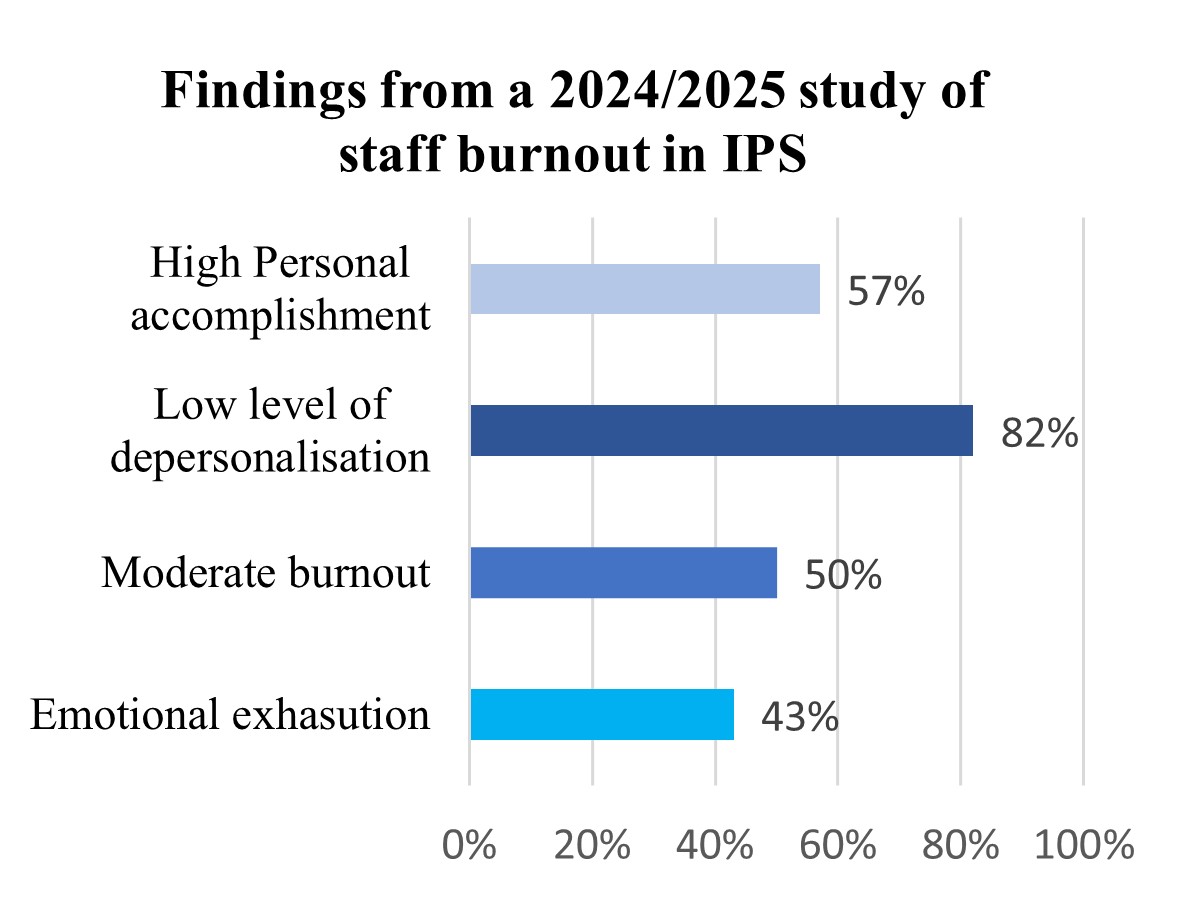
ion fatigue, and secondary traumatic stress, and high levels of personal accomplishment. However, moderate to high levels of emotional exhaustion and moderate compassion satisfaction were also present, asserting that this aspect of burnout required further attention.
A subsequent mixed-methods study conducted in 2024/25 provided more recent insights into the experience of psychology staff in the IPS. Quantitative findings indicated that 43%of participants reported moderate levels of emotional exhaustion on the MBI-HSS, while fifty percent scored within the moderate burnout range on the PROQOL Scale. At the same time, the majority of staff reported low levels of depersonalisation and more than half scored high in personal accomplishment, suggesting that a strong sense of professional efficacy remains a protective factor.
Qualitative findings reinforced the importance of reflective practice, with staff consistently emphasising the value of having protected time and space to engage in reflective discussions. Flexible working arrangements, regular supervision, and open conversations about the challenges of psychological work in a prison were also seen as vital supports. However, concerns were raised about workload feasibility, increased staffing and service planning that aligns with available resources, and the importance of recognition within the wider prison system.
The findings suggest that, although emotional exhaustion continues to pose risks, overall well-being within the Psychology Service is well-supported. Staff retain a strong sense of meaning and purpose in their work, even within a system characterised by significant operational pressures and structural challenge
Implications and Future Directions
The IPS experience highlights several key implications for Psychology staff in a Forensic Setting more broadly. Firstly, open dialogue about burnout and its risks appears to be among the most effective strategies for prevention. Second, reflective practice and supervision must be embedded structurally, with adequate time and organisational support. Third, leadership has a critical role to play in modelling psychological awareness, ensuring fair workload management, and creating a safe environment in which staff feel recognised and supported.
Future priorities for the IPS include the development of a national Healthy Prisons Framework, which will address the health and well-being of both staff and prisoners. Expanding reflective practice groups, strengthening trauma-informed supervision models and leadership, and fostering collaborative, cross-disciplinary cultures are also areas of focus. Longitudinal monitoring of staff experiences will allow the service to evaluate the impact of its well-being protocol and make evidence-based adjustments over time.
Conclusion
Burnout among psychologists working in prisons is an enduring risk, but it is not inevitable. The IPS Psychology Service has shown that it is possible to create a culture that recognises these risks, provides meaningful support, and fosters resilience among staff. While emotional exhaustion remains an area of concern, psychologists continue to find purpose, satisfaction, and professional pride in their work. By embedding reflective practice, supervision, and psychologically-informed leadership at the heart of the service, the IPS has taken innovative steps to safeguard the well-being of its staff and the quality of care provided to those in custody.
Dr. Sarah Hume, Head of Psychology, Irish Prison Service